I was walking down the zig zag this week and peeked over the fence at my old garden (roses now in bloom), got a bit nostalgic and wrote a poem about the Nor’wester …
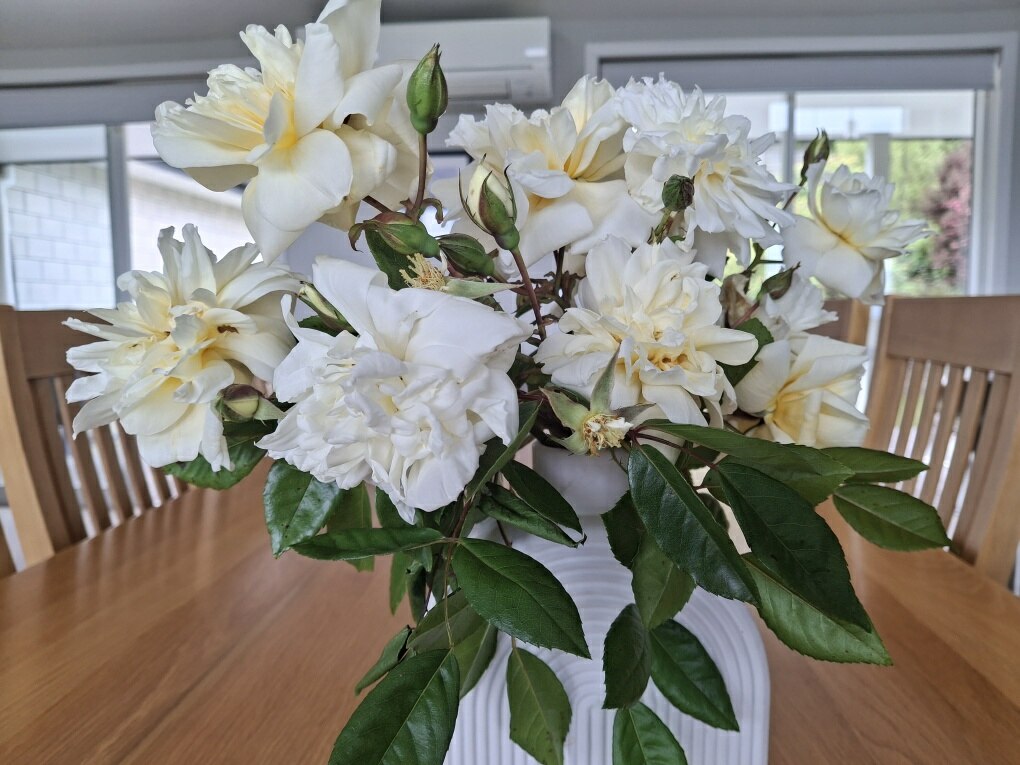
then, this morning a dear friend in Sunny Nelson sent me a photo of her blooms
November means roses erupting all over the show
bundles of scented beauty in clusters on arbours
standard and staked, rambling and rambunctious
glossy leaves before the aphids arrive, thorns
rise up and out in defence protection agents
before grandma or whomever arrives with secateurs


quickly, take yourself down to the garden to
breathe in the fragrances, heavy, light some say
green tea or honey, but rush, rush why don’t you
before that damn Nor’wester arrives
to startle the tuis, shift the kereru, entwining
cabbage tree flora to sway and dangle


why did you plant those roses right here in line
of the wind, in clay soil near the sea, surrounded
by manuka, kanuka, kawakawa, beech those
cabbage trees, the flax bushes, the kowhai
did you think your Constance Spry would not fly
away shedding petals in November?


But still, year in, year out you cosset them
Your favourite flowers, out of place in your
native garden where geckos manoeuvre unseen
where tuatara might once have been, but no
you wanted roses, by the sea, so you could
glimpse perfection, inhale summer
then you curse the Nor’wester
I inadvertently generated 98 comments on Facebook. Admittedly, many of those 98 comments are my responses to the comments. The topic is the devastating news that Alice Munro, a literary hero to many of us, had willingly and knowingly, covered up the sexual abuse of her nine-year-old daughter.
What are we to do with this news? I was first alerted when a Creative Writing teacher I admire, posted on Twitter that she will never teach Munro again. I was taken aback by this and even once I knew the full story, I wondered if this cancelling of Munro was the right thing. It ran through my mind that teaching Munro in the light of this new evidence would be, well potentially fascinating. But then I stopped and thought about this and realised it would be vicarious and abusive to have students interrogating stories she has written that allude to such abuse… something akin to abusing her daughter all over again.
Another friend described what Munro has done as reprehensible but also ‘moral frailty’ and I liked this description. But it also appears to forgive or excuse, and I found myself, to some extent wanting to do this. Someone else in the lengthy thread mentioned that often mothers who have themselves been abused are more likely to turn a blind eye when abuse happens to their own daughters. I recall a school friend who I stayed in touch with, she married early and had four or more children. She married the boy who used to deliver our fruit and veges. We knew his Dad and we knew him. He had the loveliest open face and was a hard-working reliable young man with an alcoholic father. Roll forward many years, and my friend left her hard-working husband whom we all really liked and admired. It turned out he had been physically abusive. It turned out too that my school-friend’s father had also hit her mother. She told me her mother had ignored her black eyes.
Someone else posted a link to an article written by the daughter of Jan Morris, another one of my literary heroes. ‘Conundrum’ was a ground-breaking memoir in 1974. Morris’s travel writing and more recent musings on ageing have accompanied me throughout my life. I’ve admired what appeared in the public eye as an almost seamless transition from one identity as a male journalist on Hilary’s expedition to Everest, to a gender reassignment and an ongoing loving relationship with her ex-wife (they divorced but continued to live together). It’s a kind of fairy tale. Alas, Morris’s daughter Suki Morys who was only six when her then father began his transition, sees Morris and their journey as parent and daughter in quite a different light.
Suki wrote an account of her childhood and confusion in the British Sunday Times. She claims that Morris was ‘selfish, neglectful, sexist and deeply unkind’. Gosh. And as we all recognise, every child has their own version of childhood and accounts from siblings and parents may vary. Of course, it is entirely possible Morris was all of these things and also an extraordinary writer.
But when sexual abuse occurs as in the case of the Munro cover-up, there is no alternative version. And deeply concerning is that Munro knew this would eventually be known. Such lack of courage not to have faced this head on, and to hell with her literary legacy. So, we her readers are left to loathe, cancel, or try to understand… the more comments that came into my thread, the more I realise it is impossible to understand.
A few years ago, I watched a short clip of Sam Hunt and Gary McCormack visiting a Girls School somewhere in New Zealand. I cannot locate the clip on you-tube anymore, so perhaps it has been removed. It was in the height of their fame as minstrels and roving poets. Indeed, I recall returning to New Zealand from my OE, living in Auckland and being enchanted by the sight of Sam Hunt leaping a small picket fence outside a pub or café in Parnell to entertain patrons. It looked entirely spontaneous. But I digress. The clip I am speaking of, has disturbed me ever since. Gary was wearing some very short shorts, Kiwi-bloke-style and I think Sam was in his usual stovepipe attire. The thing that startled me was these young schoolgirls sitting doe-eyed and attentive (in the company of two adult women teachers watching over them), as Sam read a poem overladen with double entendre. From my observation of the short clip, the young schoolgirls were oblivious to the sexual innuendo, but the teachers could not have been. I was struck by the power imbalance and manipulation at work. And yes, I know, it was a different era, and I might have even laughed myself, had I watched it back then. I wonder how the teachers who sat there, back then, if they reflect, feel. What might they have done? To react would have drawn attention to the inappropriate insinuations in the ‘poem’… letting it wash over their heads as it seemed to, may well have been the right choice. Our lives on replay are complex as we move from an era where men set the agenda more often than not about what was or wasn’t okay.
Recently, my book group read ‘Life with Picasso’ by Francoise Gilot. It generated really strong feelings and responses. Personally, I found the book riveting and felt that Francoise Gilot had reclaimed her agency and her art along with candidly admitting to her own complicity in the acceptance of what was a very abusive relationship. I learned so much about Picasso the man and the artist through her lens and I was full of admiration for the way she reclaimed her space in the art world against all odds. The word ‘hate’ was used in regard to Picasso in some of our vivid responses to this work. Some in the group felt hate was far too strong an emotion and others were unequivocal. We bring our own stories to our reading of any novel or memoir, and I never fail to find new ways to see the world through belonging to a book group.
We read to find ourselves. Do we write to find ourselves? Was Alice Munro writing these stories because she failed in her moral duty to take the right action for her daughter, herself and her family?
But, Munro was not alone, the whole extended family were complicit in the cover-up. Her father and stepmother, even after hearing of the abuse, allowed her to go on holiday year after year to see her mother and this monster Gerald Fremlin. The idea that the father insisted her sister accompany her to protect her beggar’s belief. Imagine two daughters being molested by your ex-wife’s husband? It seems the entire family was willing to keep the silence for the sake of Munro’s literary legacy… until now where they appear to be fully supportive of Andrea Robin Skinner’s story.
And then of course, the discourse will continue, whether to cancel, Munro, (indeed all the literary Monsters) and I’ve ordered ‘Monsters’ by Claire Dederer from my local library (as urged to do in my thread of 98 comments and climbing).
Most of my literary friends are judging Munro ruthlessly and without reservation. I blame my Catholic childhood where all sins could be expunged, or forgiven with a few devout Hail Marys, and a really fervent Glory Be. I want to understand the complexity of her feelings for such a ruthless swine as Fremlin. With all the public prestige that she had, to think she needed his affirmation even more than the safety of her own daughter and grandchildren.
Is this why we read and why we write. The answers continue to elude us. The same stories repeated as if new and ghastly, yet really on replay.
And here is a brutal take down of Munro’s legacy (ouch)..

 a curious half hour