From Maleme to Mapua

Standard

I was inspired to think about this seemingly random link after reading a poem. The poem is called “Alive together” and it is by Lisel Mueller. The poem begins thus:
Speaking of marvels, I am alive
together with you, when I might have been
alive with anyone under the sun,
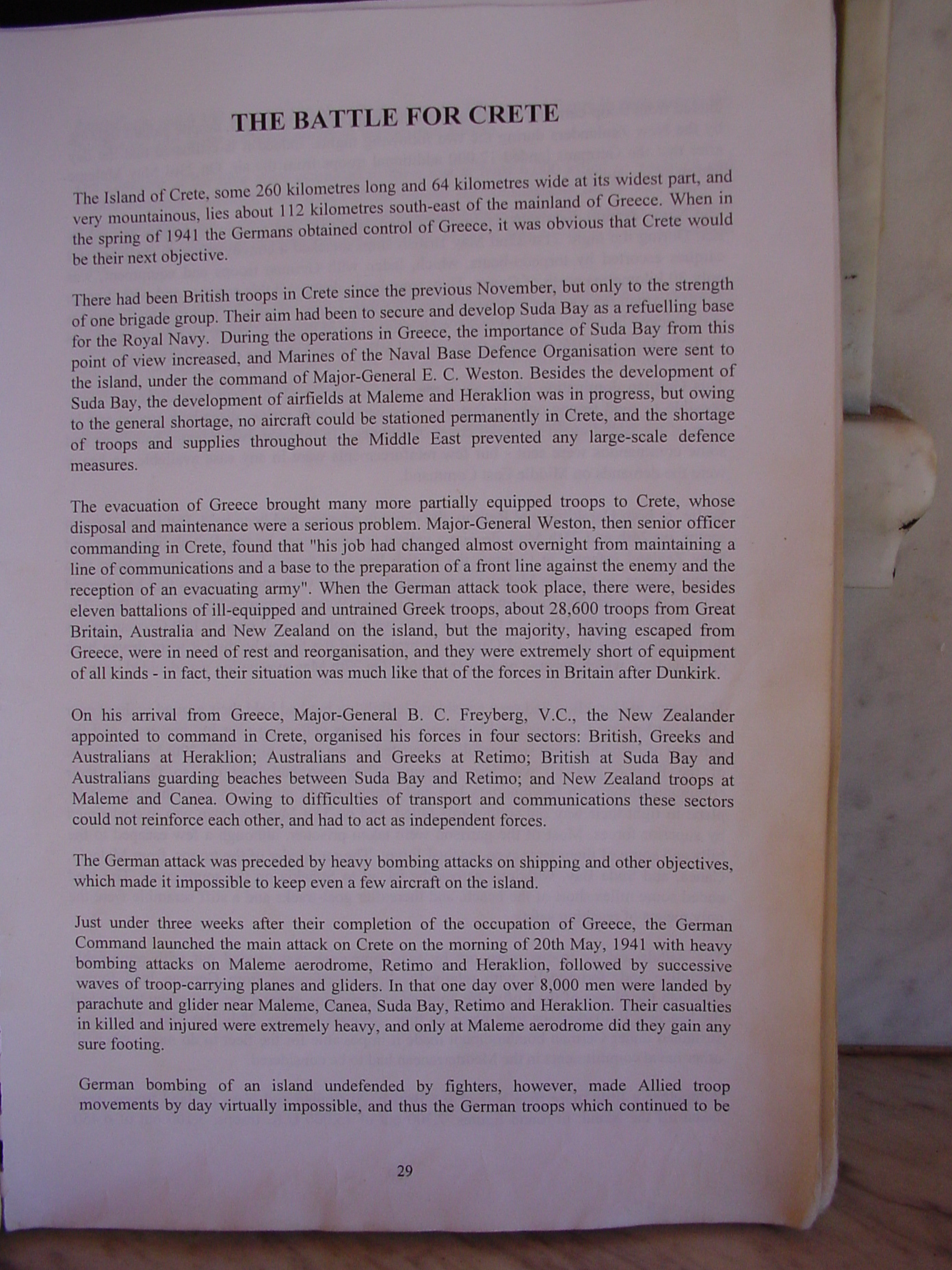
The poet goes on to imagine being a woman in a different time, married to different men, the idea of who we are being both random and minutely specific to a multitude of histories. I like this poem and I have recently been reading ‘Crete – The Battle and the Resistance”’ by Anthony Beevor. It is a very good account of a fearsome battle for control of the island in Greece during the Second World War, told from many sides of the story, the Germans, the New Zealanders, the British and the Cretans. My Dad was in the 5th field Regiment, a gunner, in the New Zealand 22nd Battalion defending the airport at Maleme, the point at which strategically the battle was lost, when it should have been won.

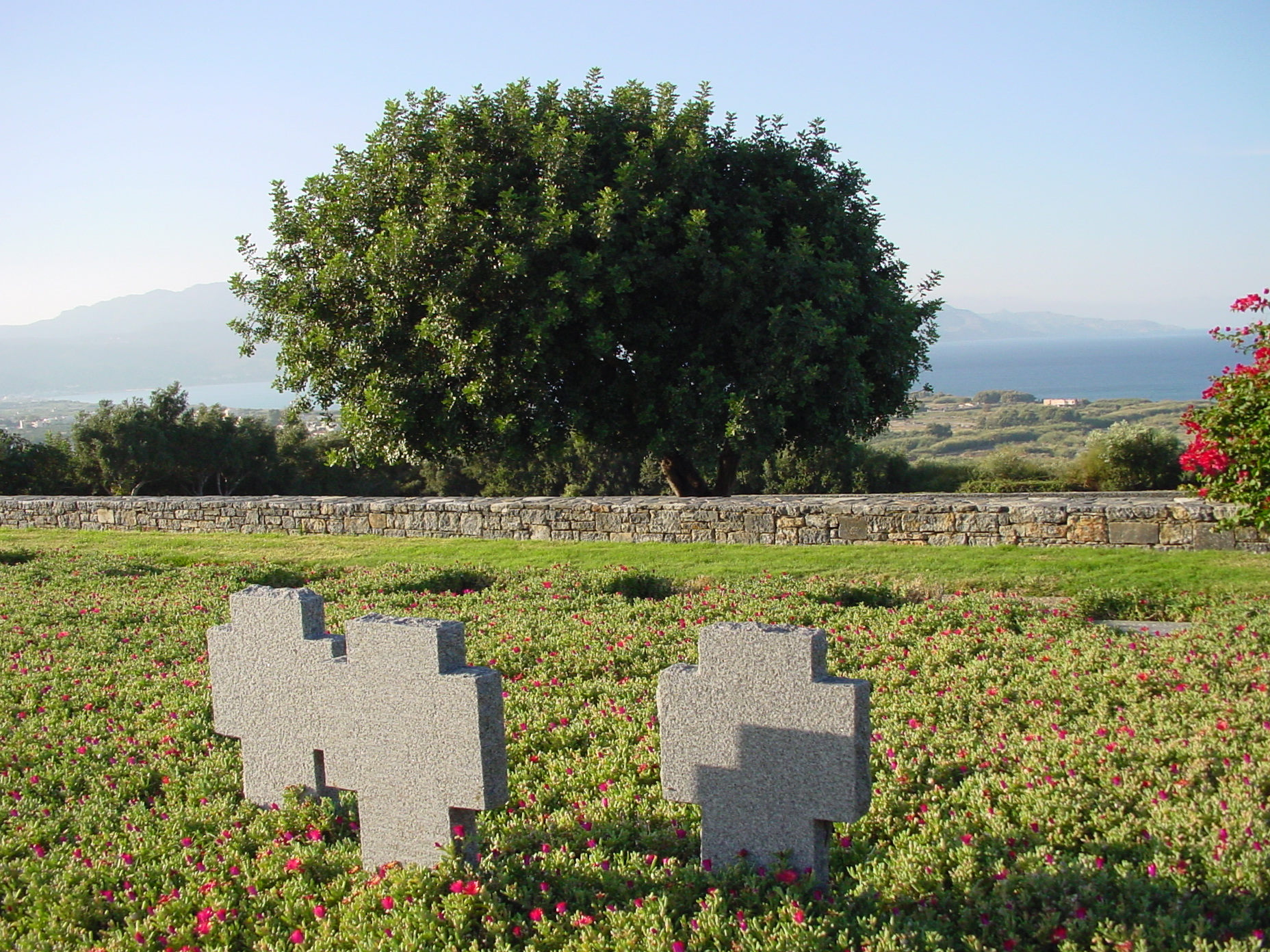
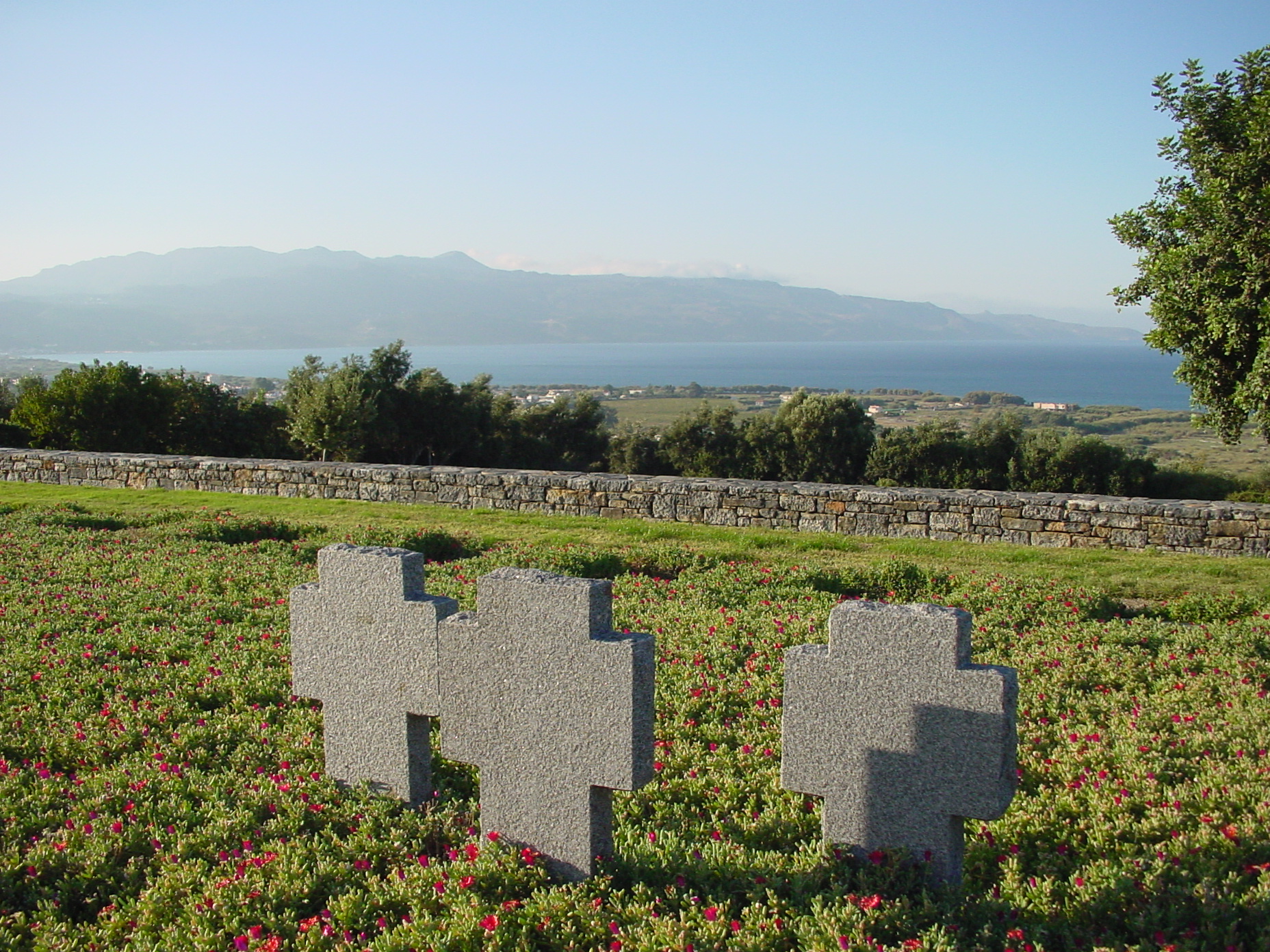
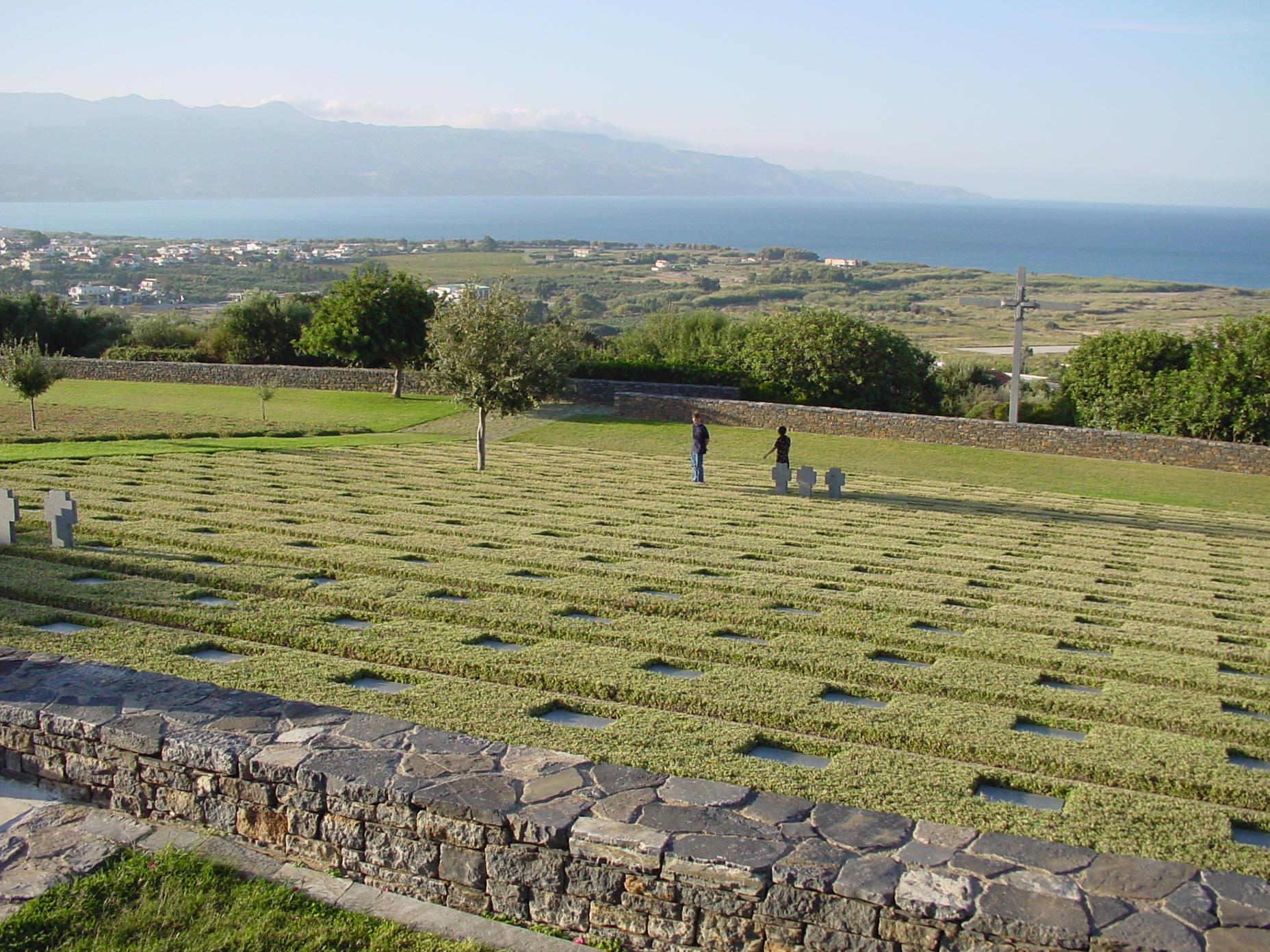
The German graveyard at Maleme

The German graveyard at Maleme

Stone crosses on the hillside among the graves at Maleme

Stone crosses on the hillside among the graves at Maleme

The graveyard at Maleme of German paratroopers killed in the battle of Crete

The graveyard at Maleme of German paratroopers killed in the battle of Crete

If, they say, General Freyberg had not been so hell-bent on the idea of a seaborne invasion… if Colonel Andrew (according to Beevor), “had gone forward before nightfall to observe the coastal trip and the western slopes of Hill 107…” … so many ifs. I imagine too, if they’d all had I phones, perhaps a few texts to and fro with some pictures attached… but then too, it seems Freyberg was very concerned about revealing to the Germans that the Brits had cracked their code, and so I guess I phones can easily be hacked . And too, imagine instead of young men dropping from the sky (like Icarus) in their parachutes, if instead, the Germans had used drones. The account of hand to hand combat between the Germans, local Cretans and the Kiwis is fierce and brutal. It seems that the Geneva convention did not apply as far as the Cretans were concerned. They were civilians defending their own patch. Oddly, the Germans imagined that the Kiwi soldiers would not fire upon them as they descended in their multi-coloured parachutes. But of course they did. And I have it first hand from my Dad, how extraordinary it was, to be firing at such easy targets, but too, how sickening. I read in Beevor’s account, how the gunners were told to aim low at the falling body because of the rapid descent, thus ensuring an accurate hit.

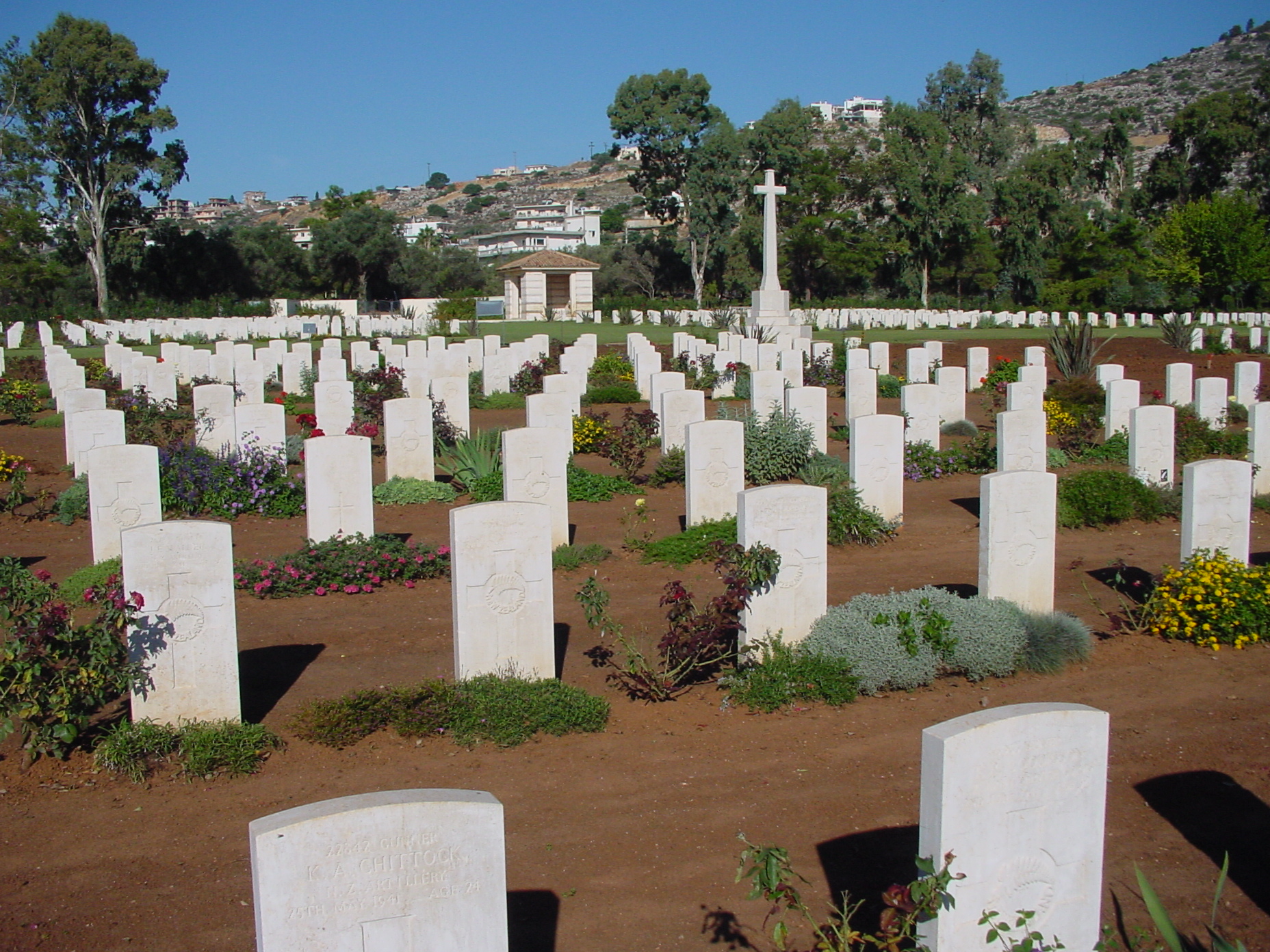
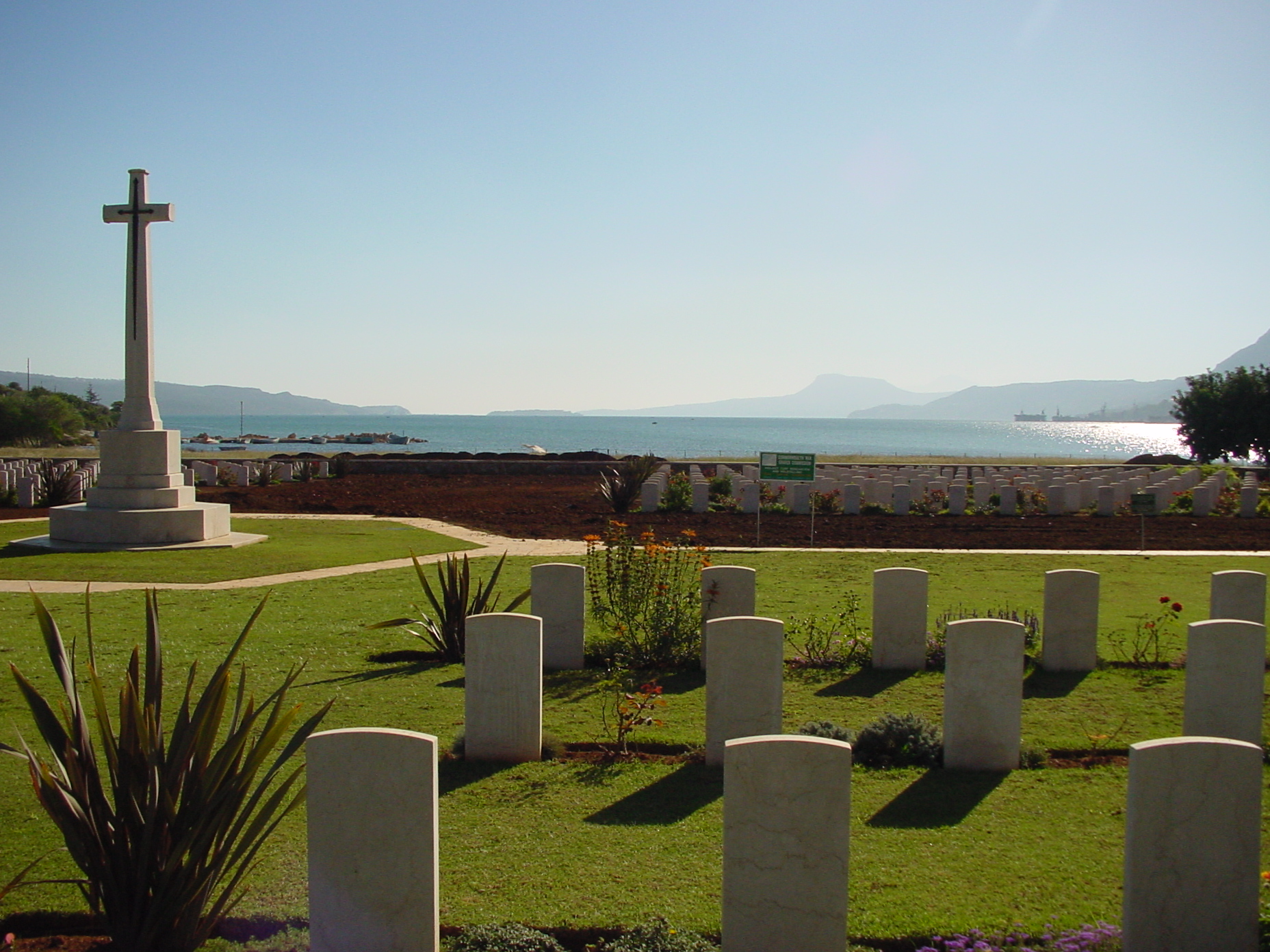
New Zealand graves at Suda Bay

New Zealand graves at Suda Bay

Suda Bay cemetery where the Kiwi soldiers lie

Suda Bay cemetery where the Kiwi soldiers lie

DSC00031

But in spite of this, the battle was won by the Germans, although they suffered extraordinary casualties. The paratroopers were young men (the German elite), some as young as sixteen and thousands were slaughtered in the first two days of the battle. So, what brings me to me Mapua? What is my connection? It is really rather random as I mention at the start (but then you see, don’t you, how random all of our histories really are).

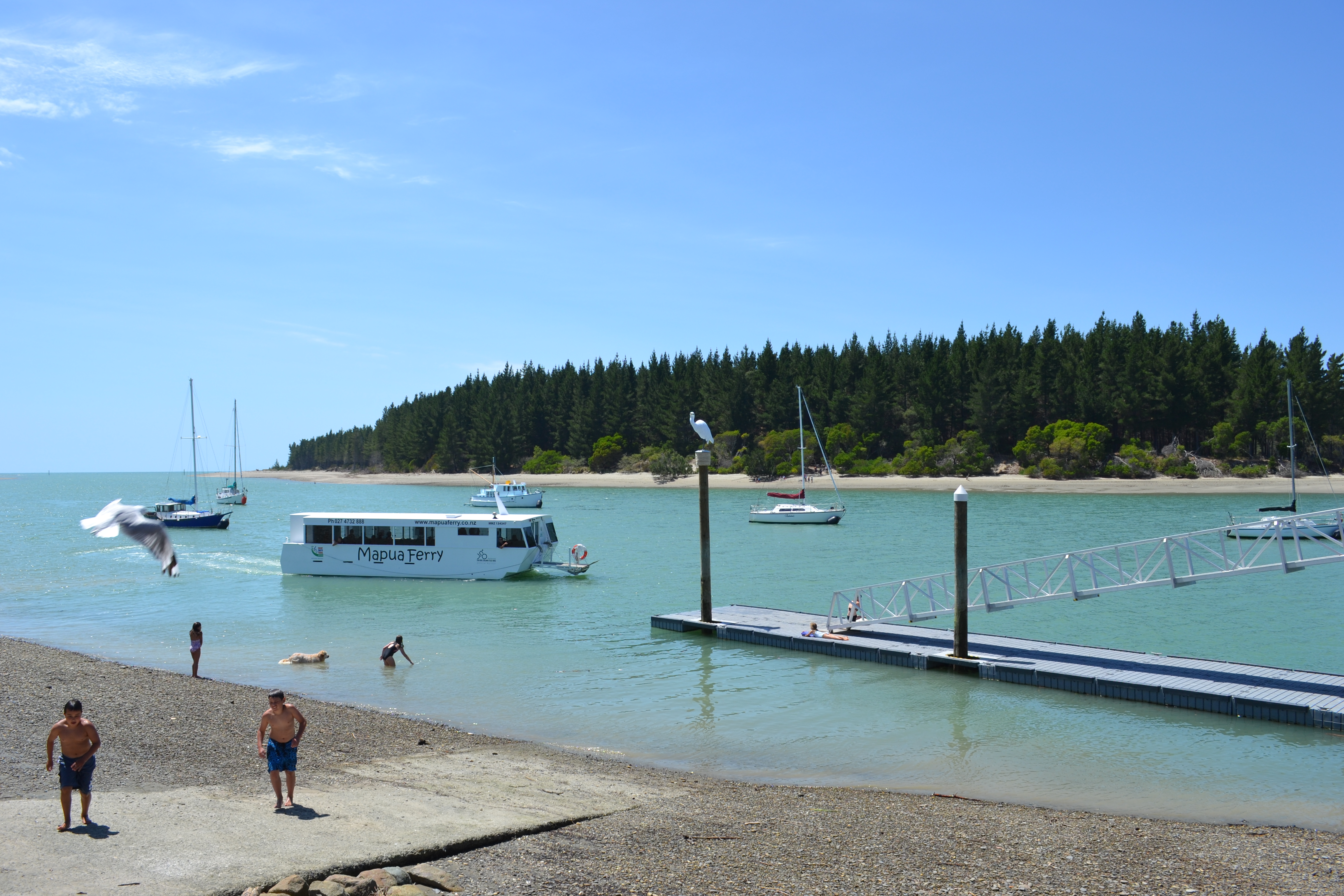
Mapua wharf with the ferry that crosses to my favourite childhood beach, Rabbit Island

Mapua wharf with the ferry that crosses to my favourite childhood beach, Rabbit Island

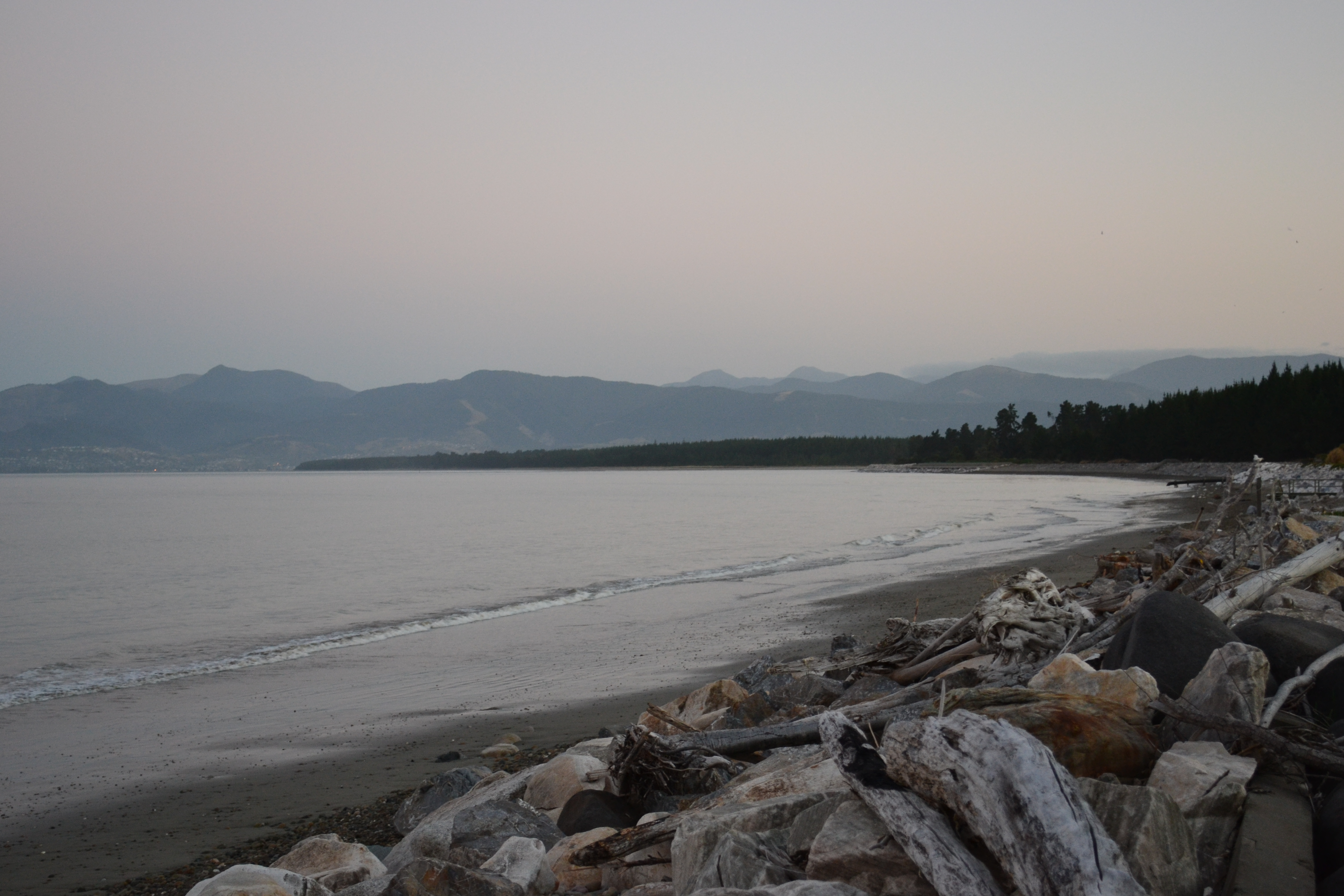
Ruby Bay

Ruby Bay

Ruby Bay

Ruby Bay

I was reading about the Battle of Crete, perched on the seafront at Ruby Bay (a hop skip and a jump from Mapua where I drank my morning coffee and had these thoughts) and I realised that if the 5th Field Regiment had held the airfield, I may not have existed. The defence of Maleme would have required a further battle – my Dad instead of retreating might have died in the ensuing violence – or so I told myself under the hot Tasman sun. That he survived to be taken POW and then shipped on cattle trains to Poland to spend four years as a POW – not to mention the subsequent 600 mile march in snow at the end of the war … well, that is neither here nor there, because this is what happened and so I know he survived all of this. But too, at each step along the way, there are a multitude of ifs to consider.

And as a result of my father’s war experience, I am fascinated with Greece, with the Battle of Crete, and too, I am ‘alive together with you, and you, and you (my family, my friends, my readers)… and there’s something both thrilling and fateful about this very being alive. If the chance came, would you change your life, be an entirely different person? As a child I used to look at people and try to imagine what it might be like to be them and then be terrified that I had wished too hard and what if I did become them and I didn’t like it and then I couldn’t get me back. Whatever befalls us, we may wish it had not, but do we ever really want not to be ourselves? Perhaps some people do (and here one can imagine a child in the slums of Mumbai). I am currently reading ‘Behind the beautiful forevers’ by Katherine Boo. Yes, perhaps if I was atop a rubbish dump, scavenging for a living, I may well be happy for my wish to be granted… but thankfully in my own fortunate life … it is enough to be ‘alive and together’ …
the poem ends thus:

alive with our lively children
who — but for endless ifs —
might have missed out on being alive
together with marvels and follies
and longings and lies and wishes
and error and humor and mercy
and journeys and voices and faces
and colors and summers and mornings
and knowledge and tears and chance.

Isn’t it just a grand poem? I have Diana Gilliland Wright of Firesteel to thank for her blog which alerted me to this beautiful poem and of course, if you wish to read the entire poem, click this link to Firesteel.

Ursula LeGuin, High Tea and the Menopause

Standard

Ursula K LeGuin, High Tea and the Menopause

Recently, I attended a high tea for a friend’s 70th birthday.   We were all girls and we dined on dainty sandwiches, sipped tea in china cups and ate pretty cakes.

My friend is a writer and she asked if her friends would bring a poem they could read at her birthday.   She especially wanted something that spoke of age and being a woman.   I took my ‘Menopause’ poem and read it.    It seemed to strike a chord.

I’m in that genre now, the one made famous by Ursula Le Guin in her essay on ‘The Space Crone’.  In fact I think I’ve passed through the planet Altair already.  My poem is a response to Ursula’s essay.     It had its debut in New Zealand Books, Volume 17, Number 2, Issue 78 in the Winter of 2007.     I see that New Zealand Books will soon be celebrating the launch of their 100th issue at Unity Books in late November.

Menopause

(Inspired by an essay by Ursula K. Le Guin “The

Space Crone” 1976).

Ursula urges me to

become a Crone

to not bemoan

my declining hormones

to wear grey hair

catch a space ship

somewhere out there

so I can share

my wit, my wisdom

my years of fertility

raising children

(ensuring my humility)

so the fourth planet Altair

can learn about the human race

from a woman (once a virgin)

and now a Crone  (on loan)

But I’m all for my inner space

and I won’t go grey

well, not yet, not today

there’s plenty of time

because I still want to play

to flaunt in the twilight

my age now my highlight

on the cusp of something

almost a Crone – not quite

ready for Ursula’s throne

but not afraid either

thumb out – hitching a ride

not looking back, nor

particularly forward

pausing as they say – oh,

but not for men

for me.

©  Maggie Rainey-Smith

Working in the Sixties

Standard

I recently had a poem published in ‘Typewriter’ an on-line journal for emerging poets edited by the delightful Elizabeth Welsh, a poet and passionate supporter of other poets.

The poem is about my first job really, as a shorthand typist with the Post Office in Nelson.    That’s quite some time ago now.   But it’s got me thinking about those times and how it was I ended up there and what it felt like.    You have to cast your mind back a bit to the 60’s when girls like me had to choose between being streamed ‘professional’ where you could study French and German and go on to become perhaps, well, ah… usually a nurse, or a teacher.   And then, if you wanted to learn to type, you had to choose ‘commercial’ and never the twain shall meet.

I wanted to be a reporter, as I recall, and I knew that I would need shorthand.   I didn’t know anything else and to boot, I had a very glamorous single (maiden or unclaimed treasure as she called herself) aunt, who worked at the Post Office.   It was my aunt who came to our house and tested my shorthand prowess which did reach 120 wpm at one stage.   It was she too, who gave me my first portable Olivetti typewriter to practice on.

Years later, when I was running my own recruitment company in the late 1980’s and the share-market plummeted, I recall meeting young women from private schools whose ambitious parents and teachers had refused them anything so ordinary as learning to type.   Oddly though, at this very point in history, the computer keyboard was becoming integral to most people’s working lives.  Being a touch typist, as I am, is a big advantage to anyone, male or female.

Yes, I learned to type at Waimea College, one of the first co-ed schools in New Zealand.   I sat in the commercial class with a bib over the typewriter keys so that now I can rattle off a book review or a blog without having to look at the keys, or to do the one-finger peck-peck that so many people are reduced to.   At one stage in my illustrious typing career (admittedly on an electric typewriter), I could do 100 wpm typing.   Indeed – I cannot vouch for absolute accuracy at this speed.     On an old manual typewriter, I think the top speed was 60 wpm to pass my Public Service examination.

Back then, in my first job, we sometimes had to type with up to six carbon copies, and that meant if you made a mistake, you had to erase all the copies one by one (Twink I think – I can’t remember) and I often ended up covered in carbon – no long-sleeved white-blouses for me as I stretched across the carbon copies.    I was always glad that I wasn’t a legal typist as they had to type perfect copy without erasures or amendments.

I wasn’t a super-star shorthand-typist because I had a tendency to day-dream.   Back then it was considered a lack of focus and I struggled with this, but now realise that probably I was bored with the content of much of the stuff I had to type and didn’t pay sufficient attention to it.   Yes, back then, I felt somewhat of a failure when I had to do”retypes” and watch my rubbish bin fill to overflowing.   I think I might have even smuggled out some discarded copy under my cardigan to avoid the embarrassment of yet more wasted paper – goodness knows what I did with it, but we did have a coal range at home that Mum cooked dinner on, so perhaps it went in there.

We used to clean our typewriters every Friday in the afternoon before we knocked off.   I had the uncanny knack of dismantling bits and pieces of my typewriter (unintentionally) as I cleaned it.   As I recall, I ended up with several pieces of my typewriter sitting in a basket beside my typewriter – and fortunately back then these old machines were so sturdy, that it continued to function, minus these missing parts.

I also operated the switchboard when it was my shift to do so.

That meant headphones on while typing and stopping mid-flight during a memorandum and transferring calls from outside to inside extensions – the criss-cross of cords as described in my poem – here’s the link.  You could eavesdrop to if you were that sort of girl, but of course I wasn’t!

From memory there was talk back then, that typists pushed the equivalent of ‘tons – tonnes’ per day, with the sheer pressure required to push the old manual keys.  I know our hands were held higher than they are for a modern electronic keyboard and you couldn’t just peck-peck.    Unless you were doing a stencil and you had to be very careful when pushing the letter ‘o’ as if you pushed too hard you cut the ‘o’ completely out and ended up with a black dot on the page instead of the lovely circular letter.

Recently, a librarian responsible for choosing books for the Catholic library service throughout Germany made contact with me.   He’d read a book review I had written for a book he had also reviewed and liked.   He had also read my blog about teaching English to German High School students.  And too, I think because of the Frankfurt book fair and the current interest in New Zealand writing.   I asked him about Catholic libraries and he gave me a very brief history which evidently go back to the second half of the 19th century.   “In those times Catholics were a (huge) minority in the Prussian dominated “Kaiserreich”.  Most of them lived in rural areas, worked as craftsmen and farmers and only a few have had an academic education, most of them were priests. Some of those academics saw the need of education for as many Catholics as possible.”  He said that after World War II, the libraries broadened their scope and now run more or less like any local library with a wide range of contemporary literary fiction, children’s literature, as well as gardening and cook books.

This reminded me of how it was back in the 50’s and 60’s in New Zealand.  I’m only quoting hearsay and legend, but it is said that many private companies wouldn’t hire Catholics and so by default many were in the public service.  My Aunt and two of her brothers worked in the Post Office and it seemed only natural that I would follow in my Aunt’s (to me glamorous) footsteps.   You see she drove an apple green, hand-painted Morris Minor, while we didn’t own a car.  She also earned more than my Dad (he was a carpenter) and she had an amazing wardrobe which included many pairs of stiletto shoes.    What else was there to aspire to?

I never regret the Commercial path that I took.    In the early seventies, I worked in London, Newcastle, Manchester, and Edinburgh as a Temp Secretary – and late in life, I’ve found my feet as a writer – typing has proved a most fortunate and useful skill.   I never did get to be a reporter, but I am now doing book reviews and blogging as well as working on my fourth novel – so yes, typing turned out to be the right thing after all.

Diana and the Golden Apples

Standard

 Diana and the Golden Apples

Recently, I wrote a piece of ‘flash fiction’ for National Flash Fiction Competition, inspired by the word limit.    I wasn’t placed, but it was great fun and it also inspired another piece which I sent off to the 4th floor journal.   I’m delighted to say this piece has been accepted for publication.   What I now realise is that neither of my short pieces is fiction.   But it doesn’t matter now because the idea, and the containment required by the word limit, freed me up to write.   My piece for publication in the 4th floor journal is a heart-piece.  It came out in a ‘flash’ and so I’ve lived up to one half of the flash fiction challenge.

I really like shape and form for poetry too.  I’m struggling at the moment with a poem that isn’t working and so I’m going to try out various forms like the villanelle (one of my favourite forms) and perhaps the possibly more difficult sestina (which actually I’ve never done before).   If I succeed, and my poem is accepted, I’ll post a link to it!   The problem with this poem is that I’ve chosen a theme before I’ve begun my poem – not my normal way of writing – and I think therein lies the problem and why the poem isn’t working.   I’m going to try and harness that through the strictness of form and hope that the repetition will drive me to the heart of the poem.

I see that in my last blog about the Literary All Blacks (about which now I feel a sense of regret for having not mentioned so many other talented writers who should be in the team) – that I mention our old blue Bakelite radio – and interestingly, the blue radio pops up again in this very short piece of ‘flash’ non-fiction.    I hasten to add that perhaps flash in this context means written in a flash rather than the presumptuous idea that it glitters somehow.

Golden Apples

 She had the whitest teeth of anyone I knew.   And milk spots, too.  I never knew how white could show on white, but it did.  Her hair was Heidi and Rapunzel all in one, two strong yellow plaits.   She lived near the showground, close by to the blue gums.  I sometimes wanted to be her.  On weekends she rode her horse in those fields far from my house.   I found a photo recently of her, at the local A & P show, riding her horse without a saddle, carrying three apples on a plate.   Four jumps, it says, she must clear, without spilling a single apple.  I imagine her concentration, her plaits flying outwards from under her little black rider’s cap, knees pressing the horses flank.   I hear applause, smell the candy-floss, and taste toffee apple.

I am reminded of the story of ‘Diana and the Golden Apples’ – Sunday mornings beside the blue Bakelite radio.  How my heart raced every time I heard this story.  Even knowing Melanion would win, I still waited each time Diana stooped to scoop the apple, terrified unless she slowed a little.   And too, relief, when at the final drop, the apple cleverly was heavier, and just before she caught him, Melanion crossed the finish line.

I’m much older now and I know that girls with golden plaits and golden apples are the thing of myths.  I know that Melanion still lives in the hearts of many an old woman, but he’s been supplanted too, by real men, along with some rotten apples, and a few that never quite ripened.  I imagine these old women slowed now with weight of all those apples.  I see them smiling, as they watch, Melanion running on ahead,  laughing, knowing he’s really running away from them.

Tolstoy and the Chambermaid

Standard

Tolstoy and the Chambermaid

Forty years ago, I was the chambermaid reading War and Peace in the beautiful Haukeli Mountains in Telemark, Norway.  It’s quite a big book really, and the reason I became absorbed was two-fold.   First of all, I couldn’t speak Norwegian very well, and the book became my companion on my work breaks, something to engage in when I couldn’t hold a conversation.    Secondly, I had purchased a number of literary classics on my classic Kiwi “OE “ while living and working in London, Newcastle, Manchester, and Edinburgh –  as part of my literary self-education.  Now here I was in Norge reading Tolstoy surrounded by snow, metres deep on the sides of the road … the perfect setting.   Even you might say, as close to Russia as a Kiwi girl could imagine being at that time in my life.    A couple of years later, I was on a train in Finland that stopped right on the Russian Finnish border and we (my now husband and I) were arrested for taking photographs as we walked towards the Russian border.   And that is still as close as I have been, but I do dream one day of actually getting there.

I fell in love with Vagslid, a most enchanting area which includes the Vagslid Vatn (lake) and beautiful mountains.   I learned to ski here, at first unable to even stand on skis on the flat, and then eventually able to set off alone, to traverse the frozen and snow-covered lake, to climb and ski to places with magical names like Fossen, Langasae, Åmlinuten.        I was a chambermaid and a waitress and Norway was newly rich.   I knew very little about waiting tables but I knew how to make hospital corners when making beds.  I’d learned this the previous winter in Edinburgh working at the North British Hotel during the Edinburgh festival.   But I didn’t need to know so much about hospital corners in Norway, as they had duvet (dyne) bedding which back then was quite a novelty for me.   My Norwegian language skills developed in an ad-hoc way with quite a lot of Danish imellem (in-between).   The wife of the manager of the hotel was Danish and many of the young women who worked alongside of me were also Danish – I assumed we were all talking Norwegian! My very first Norwegian phrase that I learned to say off by heart,  was Vil du være så snill å våkne meg i morgen which translates as “Would you be so kind as to wake me in the morning” (travelling as I was sans alarm clock and possibly back then, sans watch).

I plan some day to re-read War and Peace because it is such a long time since the first reading in my very early 20’s.  I’m sure that a re-reading will reward.  My hope is that I am en-route to Russia when I do this so that I can inhabit not only the pages but the real landscape.     I’ve just been reading a book to review which is based in my favourite city, Wellington.   Someone I was talking to recently, said that they love Wellington because you are constantly in touch with and aware of the elements.  The book that I was reading milked all of these elements for atmosphere and to convey somehow the mental collapse of one of the characters.  I liked the weather, perhaps even more than I liked the characters in the book.  But it struck me that as readers we inhabit so many physical landscapes in our imagination and when we encounter a landscape we know, it is doubly exciting, if done well.

Here is a recent photo of the snow at Vagslid where I spent three winters and one summer, the first winter by myself and the next two winters and one summer with John.   We have some terrific photos of our own, but mostly they are old-fashioned slides which we need to convert.

Together our greatest skiing triumph was the return trip through mostly virgin snow from Vagslid to Saesnuten and back (if I recall correctly approximately a 40 kilometre round trip). Here is a poem I wrote inspired by Vagslid.

Cross Country

From Hogmanay to Hauklisetter
the Telemark Waters once liquid
solidify
I learned to ski, instead
of love
Carol King’s earth moved
Under my feet, the frozen
possibilities
assumed a shape, snow on
ice, ice on water
Boats upturned lay lost
til summer
Fossen was a destination
and destiny
a frozen fragment
I followed reindeer
tracks, when I
might have followed you

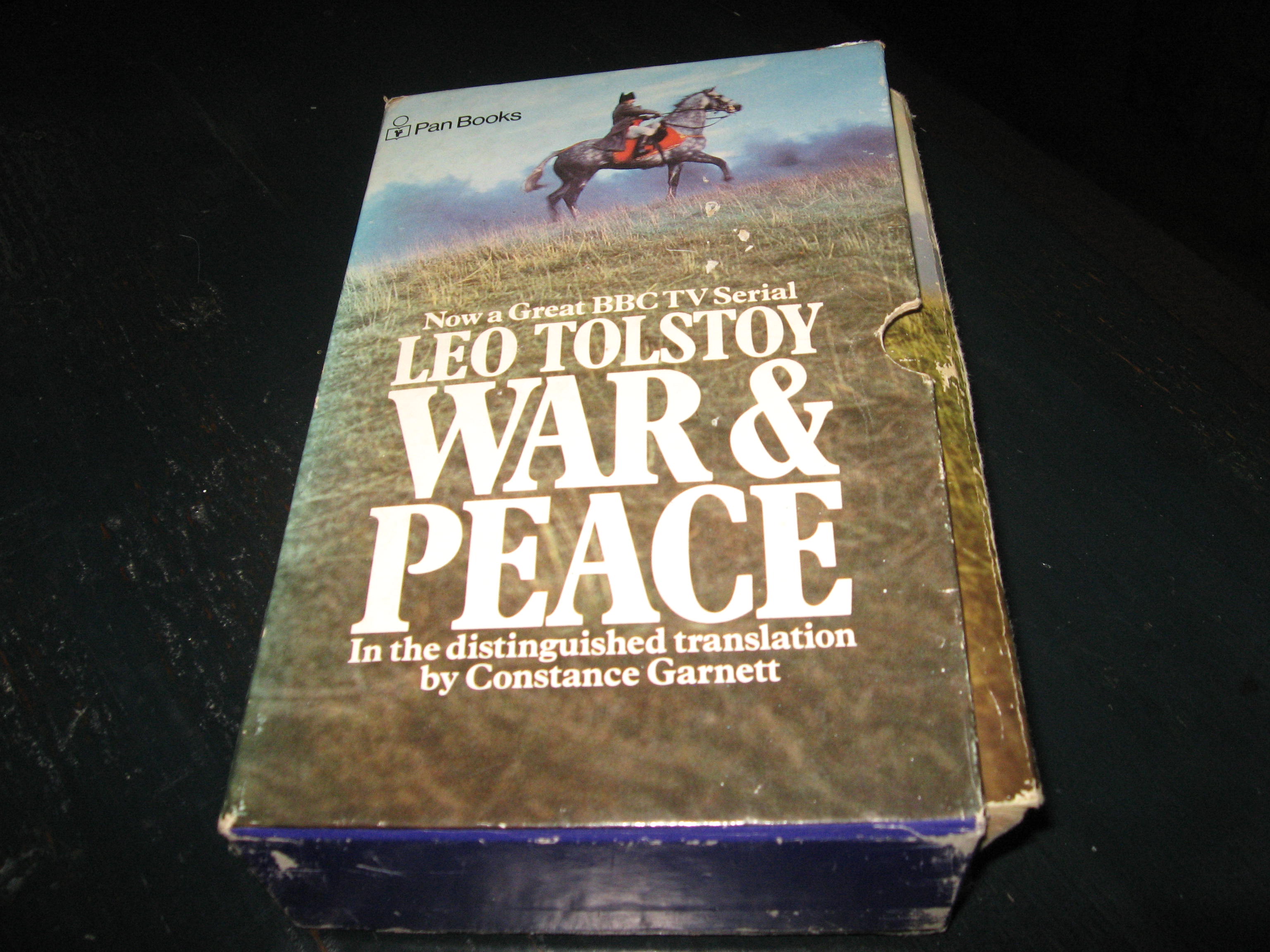
And here is, a photograph of my battered copy of ‘War and Peace’ a Christmas present to myself as you will see from the inscription I have written, in Edinburgh, Christmas, 1972.

This was my very first Christmas without family, and as I seem to recall, without flat-mates either, as I think they’d all escaped back to the Scottish Highlands or Europe for the festive season.

Tolstoy was my consolation and he travelled with me to Norway.   Thinking of War and Peace I was reminded of the amazing spirit of the Norwegian  people recently when they gathered in Youngstorget Square, 40,000 of them, to sing ‘Children of the Rainbow’ to celebrate multiculturalism in defiance of Anders Behring Breivik.

Autumn, Anzac Day and Gerard Manley Hopkins

Standard

Autumn, Anzac Day and Gerard Manley Hopkins

Where we live, in the bush, by the sea, autumn for me is the best time of year.   We moved to our house on the hill in autumn twenty something years ago, and it was the still air, the mellow sunshine, and the leaves dropping in the garden, that captured our hearts.   The harbour is quieter this time of year, calling us to kayak.    The cicadas have ceased their courtships and the wasps are out, lured by the Easter spices.   I’m affected by the light, the warmth, the sense of peace that only autumn seems to bring.

And then, it is Anzac Day and the brass band, the bagpipes and the haunting bugle, bring another layer of nostalgia peculiar to my Kiwi childhood, that lovely in-between season thing where summer has ended, but winter hasn’t yet begun.    I ran behind my granddaughter today on our nature walk, she was wearing a hand-knitted cardigan in strawberry, aqua and bluish hues.  I watched her back running through the bush collecting special sticks so we could block the creek further up the hill.  When she snuggled for a cuddle I could smell shampoo and wool and the damp soft mud beneath our feet.  I bought her a poppy to wear on Wednesday and she loves red.  We looked for the toadstools we’d seen the week before, and mourned their loss, wondering what had happened to them.

I was reminded of this beautiful poem by Gerard Manley Hopkins that I only encountered late in life studying English Literature at Victoria University when I was 50, and indeed, I used a line or two of this poem in my first novel ‘About turns’.

          “Spring and Fall” (1880)   Gerard Manley Hopkins

 To a young child

Margaret, are you grieving
Over Goldengrove unleaving?
Leaves, like the things of man, you
With your fresh thoughts care for, can you?
Ah! as the heart grows older
It will come to such sights colder
By and by, nor spare a sigh
Though worlds of wanwood leafmeal lie;
And yet you will weep know why.
Now no matter, child, the name:
Sorrow’s springs are the same.
Nor mouth had, no nor mind, expressed
What heart heard of, ghost guessed:
It is the blight man was born for,
It is Margaret you mourn for.

My granddaughter and I will meet outside the local school on Anzac morning.   Then we will march alongside the war veterans (there cannot be many left, but perhaps from the Vietnam War), and I will be stirred by the music on two counts.  One because I was a marching girl in the 50’s and 60’s and two because I’ve always followed the Anzac Parade, to see my Dad in his shiny and freshly polished shoes, wearing his war medals that Mum would stitch temporarily on to his suit, so they hung straight.  Now I have his medals and his Crete badge and his small barbed wire pin, remnants of his war efforts.   Perhaps this year I will wear them.   When he was alive, and after I was married with a family, he would sometimes come and stay with us and we would do the Dawn Parade in Wellington and then our own local parade.   We couldn’t get enough of it.   Nowadays, I just do the local parade and adjourn to the RSA for the home-made pikelets, sausage rolls and cups of tea, followed by an obligatory beer with my friends and we toast my Dad.     This will be my first Anzac Parade with my granddaughter.

In 2002, I travelled with my husband to Greece and to Crete to retrace my father’s war journey and to Poland where he spent four years as a prisoner of war.   I wrote about it and the story was published in the New Zealand Listener.  Regrettably, I inadvertently wrote of Stalag VIIB instead of Stalag VIIIB, and neither the Listener nor I picked it up before it went to print.

Here is a link to the story: Looking for Curly

What prompted this post about Anzac Day is one of my favourite blogs Surprised by Time.and on reading this blog I found more information about where my Dad might have been on mainland Greece, before arriving at Suda Bay for the Battle of Crete.     This is part one of a two-part blog that includes excerpts from New Zealand and Australian veterans of the Greek campaign, both on mainland Greece and Crete. It is well worth reading.

Mulling it Over

Standard

A couple of years ago, a friend of mine, Mary McCallum decided she would begin hosting poems on her blog.    It sounded like such a fun thing, and as it was around Easter, I suggested that I had a poem she might like.    Well, Mary is a very talented poet and a perfectionist.   I sent her my run-on Easter poem and we chatted via email over the weekend before it was ‘published’.     There were queries about words and line breaks and eventually, my run-on poem became the shape of an Easter cross.    Yes, I can’t take the credit for this, was the clever eye and editing of Mary.    I like the cross, and too, I liked the run-on of the poem when it wasn’t a cross.   It’s interesting how a poem can change shape and yet the meaning more or less remains.   I’m not big on overt symbolism so I worried that my poem wasn’t strong enough to carry the Easter Cross.

I am going to re-post the poem here on my blog, without the shaping, first because  it’s tricky on a blog to get the poem to stay in shape, so hat’s off to Mary, but also because I thought the poem might work in its more or less original form, as a kind of run-on.

Mulling it over

Cinnamon, cardamom, almonds

and wasps, plump imported raisins,

currants;    Uncle’s aluminium pan.

The sunlight is thinner and Maria

who is Greek is fasting; orange peel

floats in the dark pool of wine.

I add sugar and schnapps, watch

the liquid almost boil and ladle it

into warm mugs.  We breathe in

the alcohol, swat at the wasps

remember last Easter and the one

before.  We marvel at the yeasty buns

suck the sticky glaze from our fingers

and lift the pale crosses to our lips

knowing that Pilate will wash his hands,

Veronica will wash his face, a

soldier will lance his side, and that

he will chat to a couple of thieves

just before he dies.   But, it is

the triumph of the empty tomb

we most admire as we raise our

hot mugs of wine in relief, glad.

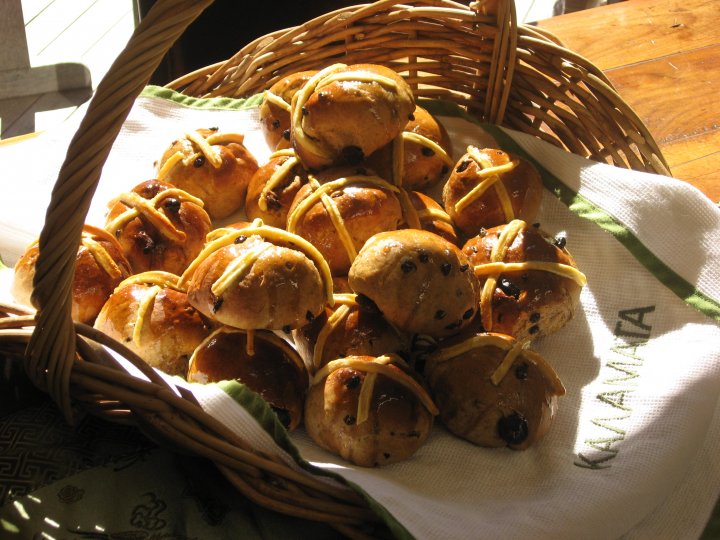
Although, I’m not religious, I love Good Friday and the poem is about the way we celebrate our Good Friday.   We have friends over to eat my home-made hot cross buns and drink our (top-secret) staggeringly alcoholic mulled wine.   It includes aquavit or schnapps, Muscat de Frontignac (when we’re feeling flush), vermouth and red wine, not to mention cinnamon sticks, orange peel, cardamoms, seedless raisins and almonds.   The red wine is usually run of the mill, or even cask red, as once you’ve added sugar and almost boiled the stuff…. well…  but one year, my daughter-in-law’s sister had just celebrated her summer wedding and there were a spare few bottles of rather nice red left over which were generously donated to the mulled wine.   Many of us, sipping that particular brew, rued the fact, we’d cooked it!    The buns have crosses, but my family get their own bun decorated with their initial instead of a cross, and now I have a granddaughter who has the same initial as her father – they are both the ‘S’ bun.   My youngest son is a ‘T’ bun, which is more or less, a cross I guess, but as he lives overseas, there won’t be a‘t’ this year.

When I say I’m not religious, this does rather omit my Catholic (leaning toward Irish) upbringing.   So, I have fond memories of Good Friday, the three-hour pageantry, the stations of the cross, the kneeling the standing, the drama.   We had handsome Irish priests to lust after, and one passionate local priest, Father Bradford who would hurl himself at the floor in true grief at almost every station, building to a heart-rending finale.   I was glad when Simon came along to help carry the cross, I loved it when Veronica wiped the face of Jesus, and we all fell in unison, once, twice three times, when Jesus fell, down on our knees, urged on by the theatrics of  Father Bradford.   But, I must confess, I was sometimes distracted by the gorgeous outfits of the girls from Waimea West by the time they laid him in the tomb.  You see, Easter was a time of religious fervor and fashion.  It was the between seasons moment when you could wear your new winter outfit, and admire everyone else, including their hats.   We were a small parish and at Easter for some reason, we would collect the surrounding countryside parishes into our church – oh, a host of fabulous fashion, girls my age whom I saw perhaps once or twice a year, and we’d all be wearing our very best brand new Easter outfits.  Yes, I loved the Stations of the Cross, Father Bradford leading us in what was I suppose, our own modest Oberammergau – we were part of the passion play, standing, kneeling, in thrall to his grief, perhaps exploring our own, and peeking, as you do, to see what the girls from Waimea West were wearing.

Postscript:

A curious thing; my links are not working unfortunately, on either this or my last few posts.  I have sent a message to WordPress and hopefully I will find a solution.   So, in the meantime, if you wish to see the poem as an Easter Cross as first published, try this http://mary-mccallum.blogspot.co.nz/2010/03/tuesday-poem-mulling-it-over.html.

Also do check out the Tuesday Poem blog which has now taken off and is a big success – so well done to Mary and all the other contributing poets.  http://tuesdaypoem.blogspot.co.nz/

As much as you can

Standard

A friend recently alerted me to the poetry of Cavafy and I have found this one poem that I love (as well, of course, as many other divinely sensual poems)… ‘As much as you can’.

The reason I chose this poem to write about is because of the addiction I have felt recently to social media, Facebook, twitter and following other peoples’ (mainly writers) blogs… and too, the emptiness that this feverish addiction can leave me with.    A kind of literary on-line party that has no ending. And lately, it has begun to feel as if all the words, the poems, the cacophony of literature, are but a clamour, and not as I thought them to be, a balm.

Cavafy exhorts us to not degrade our lives with too much contact with the world, activity and talk, and to stop dragging our life around to parties etc, until our life ‘comes to seem a boring hanger-on’.

Writers have this challenge – the solitary life required to write, and the need to inhabit the real world in order to have something to write about.  I’ve been struggling since my last posting to find a topic, to feel the passion for my topic, to feel the confidence that anyone would care to know my thoughts and this lead me to my favourite quote by Brian Epstein  which I read at the launch of my second novel – because it summed up how I felt – this lunacy, this nuttiness, to imagine that words I might choose should have any significance, or indeed that anyone might care to read them.

Then, this week I followed a link on twitter from the International Institute of Modern Letters  with quotes from writers about the best and worst things about being a writer.   Some are short and pithy and some more belaboured and a wee bit defensive (as per James Brown, who tells us that because he is published by Victoria University Press, some people envy him, perhaps think him too successful).   He’s a talented, witty poet and of course we all envy not just him, but anyone blessed by VUP because they hold sway, have cache, and denote a certain high-water mark – not everyone’s tide goes that high.   I liked what Victoria McHalick said in two short sentences about freedom versus the pay and too, I enjoyed Hinemoana Baker who worries about her mother and father who worry about her finances!  Yes of course, but I bet they’re very proud as well.

And this week, I was talking with other writers about where to send their (my) work – how we choose which press, which publisher, to submit to and where we fit.    We are aware that there are some publications where our style, our genre, our voice doesn’t fit.   That doesn’t mean we don’t have a voice, but if we continue to butt up against this, and not recognise it, we could stop in our tracks, feel permanently rejected.

Self-publishing.   It sounds like a dirty word.   It even feels like swearing.    But I remind myself that every blog post is self-publishing and self-promotion.   And then I remind myself that I own a very precious faded red hard-back book called ‘Supper Waltz Wilson’ written and published (I think) by Owen Marshall himself at Pegasus Press.  I have a signed copy which I was given in 2001, after spending 20 weeks in Timaru at Aoraki doing the Creative Writing Course.    Owen obviously had a wee stash of these beautiful books that he’d been handing out to his students over the years – I treasure my copy – perhaps a slight over-run on the publishing front?   And now, he is one of the top writers in the Random House stable, and arguably one of our best, if not our very best short story writer.

And so as much as I can, I will continue to blog, to write, and to try to find the balance between my solitary self, my social self, my writing life and my perceived ‘real’ life.

Wives to consider

Standard

There are wives

to consider now

with two sons

and a grand

daughter

our lives have

grown, and

the photos

we found

show us

how we thought

we were

back then

but looking

at them now

is different

somehow

new ways

to see the

brothers

their father

and as

for me

well, you

can’t rewrite

history

but you can

reinvent

yourself

© Maggie Rainey-Smith 29/12/2011

Learning to sing

Standard

There is something quite extraordinary about discovering your voice.    Although…  to be fair, my journey of discovery has only just begun.   For years I have sung my heart out, but always with the knowledge that I was out of tune, “flat”, unable to match pitch.     I didn’t know it was called matching pitch, until last weekend.     I didn’t even know what a major scale was … perhaps it is no wonder I couldn’t always match pitch.

Well, what joy I had at the Reclaim your Voice workshop with the help of Nikki Berry and Gary Easterbrook, and seventeen other extraordinarily courageous women over a weekend at Turnbull House in Wellington.    We were warned on the Friday night that it would be an interesting journey and that perhaps there would be tears.   Well, I thought to myself, tears there may be, but not from me, because I don’t do ‘crying in public’ unless of course, it is a funeral.   And this was no funeral.  I had booked to reclaim my voice.   I’d been assured that this was definitely a workshop for people who couldn’t sing and not as happened when I tried to learn French and the people in the Beginners class all turned out to have studied French at school, or university.

As it turned out, some of the people in my singing workshop, actually sing in choirs, and on hearing this during the obligatory personal introductions, I felt the terror rising.    But, it turned out we all had a level of terror, even the most beautiful of our voices was constrained by some inner critic, childhood memory, grief, or embarrassment.   I was quite shocked to hear women who to me sang like nightingales, who didn’t believe they could sing.   At least my terror was somewhat more warranted.   But then too, some of my own fears were manufactured, as it turned out to my great surprise and delight, on the first round, solo, I matched pitch.  I got the thumbs up from Nikki.   I was taken aback, but found very quickly that Nikki Berry doesn’t do thumbs up when it’s not warranted.

Over and over, throughout the weekend, we sang solo in front of strangers, who became friends, shed tears (sobs sometimes), as our voices emerged, tested new styles and we sang, belt, twang, sob, falsetto… mostly new terms to me but the sounds were amazing.    People surprised themselves first and then the rest of us.  I was filled with admiration for the women who took courage in hand and wanted more, even when their voices sounded beautiful to me, they wanted more.    They stood alone in the room, encouraged by Nikki, took risks and we applauded with our laughter, and often our tears of joy for their achievement.

Don’t go away.   This isn’t therapy.   Hubby was puzzled when I told him how much I had cried.   He enquired was it singing lessons I had enrolled for?    Yes, before this weekend, I might too have looked a little askance at someone telling me how much they had cried learning to sing.     Well, as it turns out, laughing and crying are a great start for the vocal folds, and once you’ve released all that air and emotion, something beautiful happens (eventually, and after a few false starts and horrible noises), music happens, clarity occurs, voices surprise their owners.

I thought about what happened over the weekend, and it reminded me of skiing.  I learned to ski as a young adult in Norway  on a working holiday in the early seventies, in the Haukeli Mountains on what was then called the E.76 highway between Oslo and Bergen at the Vagslid Høgfjellshotell .   I had no fear of failure back then because I was so excited to have this opportunity.   Falling was just part of skiing and the snow was metres deep and the world was at my feet.    Then I returned to New Zealand and had a family in the late seventies and began learning downhill skiing, so very different from cross-country.   My fears began, I didn’t want to fall, my technique was wrong, and I was self-conscious.   My progress at downhill was so much slower than my first foray into skiing as a young woman on her OE, unencumbered by expectations and fear of failure.

But too, something else about skiing and singing…  If you’ve ever been on a crowded ski field and stopped to listen, you will know what I mean.  People don’t compete (perhaps some do), but the average family skier is just so thrilled to make it down the hill trying out a few new turns, tackling a slightly trickier track.   Over and over you hear people saying ‘did you see me’…. with joy, as much as pride… did you see me … they’re not looking at the other skiers, they’re so excited at their own unexpected progress and their families and friends are happy to applaud, agree, be delighted with and for them.

It felt like skiing a little, when I learned to sing this weekend.   Everyone seemed as happy for me as I was for me, when I sang on one note, then two notes, oh my goodness, I can sing on five notes… we were all engaged with each other and our progress was not in comparison to one other, but simply about each person’s individual progress, in comparison to their expectations (whether just meeting them, or going beyond).

Turnbull House in Wellington, lends itself to the intimacy needed for this sort of workshop.  It was here, back in the late nineties that I read my very first poem in public.  I’d just finished the undergraduate Poetry Course run by Greg O’Brien at Victoria University, and our class was invited by the Poetry Society to read.   I turned up with my whanau (husband and two sons), and the rest of my class just turned up and I recall one of my sons, who is now a builder, told me that he endured the boredom of the poetry readings by counting the ceiling panels or some such detail.  It seemed fitting that my first solo public singing, was also within these walls.

And so, I am writing to thank the extraordinary women who shared my singing journey this weekend, for their tears, for their laughter, for their courage, for their beautiful voices.   Of course, none of this could have occurred without the insightful, grounded, guidance of Nikki Berry, a talented teacher and singer.   Nikki generated an environment that was completely safe for all emotions and enabled us to take risks with our voices and our hearts.    I felt at times for Gary (the only male) who so expertly accompanied us on guitar and piano, exposed to so much joy and grief and laughter among so many women, but he didn’t seem to mind.   Evidently there are usually men too in these singing groups but for some reason, our group was all women.   Maybe this allowed more emotion, who’s to say, but it is true, that the emotions propelled the singing and made our journey all the more valuable.

If like me, you think (or know) you can’t sing, take a risk, enroll in one of these workshops and be surprised.    Oh I won’t kid you, I’m still singing out of tune, but now I know how to find that voice, how to match pitch and I am practising.  I have a song to sing to my granddaughter, and it goes like this.

http://www.libbyroderick.com/